
Review: Come From Away - Bravo Theatre Group

Society Name: Bravo Theatre Group
Show Name: Come From Away
Adjudicator Date of Attendance: 11/09/2025
Bravo Theatre Group’s Come From Away was an evening defined by sincerity, skill, and compassion — the very qualities that sit at the heart of this remarkable musical. To stage such a piece on the anniversary of 9/11 gave the performance a resonance that few shows could match. There was an unmistakable sense of reverence in the air; the story of strangers turned friends, fear transformed into kindness, and chaos met with calm felt more meaningful than ever. Bravo’s production was not only technically accomplished and beautifully performed but also grounded in a genuine human warmth that made the evening both uplifting and deeply moving.
Director Aoife McClafferty’s approach was confident, cohesive, and full of life. She shaped the piece with a smooth, flowing rhythm that mirrored the heartbeat of the small Newfoundland town at its centre. The pacing was superb, never sluggish, never rushed. Each transition, each shift in mood or location, was clean and deliberate, maintaining the sense of a community constantly in motion but never out of control. Her attention to character detail was one of the most impressive aspects of the production. Even in a show where actors play multiple roles, every individual felt real, distinct, and necessary.
The hallmark of Come From Away is its seamlessness: the ability to shift from one world to another, one character to another, without breaking the flow. Aoife achieved this with impressive finesse. The multi-rolling was handled with clear vocal and physical distinction, from the nervous travellers to the unflappable locals, and though a few Newfoundland accents wavered at times, the emotional truth of each portrayal never faltered. She created a living, breathing stage picture where no one ever felt idle. The ensemble’s constant presence gave the production an unbroken sense of connection; even as scenes shifted, the audience always felt the pulse of the community.
Visually, the direction embraced simplicity. The set was used cleverly, with performers moving props and furniture to build new worlds in front of the audience’s eyes. This practical storytelling not only aided the flow but also reinforced the show’s themes of cooperation and adaptability. Aoife’s only missed opportunity was in the limited use of the additional chorus. While the main ensemble worked tirelessly, the extra performers appeared infrequently, which felt like a missed chance to heighten the sense of scale and shared humanity. With a story that thrives on togetherness, spreading the load more evenly might have added greater visual richness. Still, the production’s overall cohesion and emotional power left little doubt about Aoife’s clarity of vision and ability to guide her cast with empathy and precision.
Musically, the show was a triumph. Under Shane Farrell’s direction, the sound was alive with warmth, precision, and authenticity. Come From Away demands a vocal ensemble that functions as one instrument, a single, unified voice, and Bravo Theatre Group delivered that in abundance. Harmonies were lush and beautifully blended, with crisp diction and clean tuning. Every swell and cadence carried emotional weight. Shane’s musical leadership encouraged not just technical excellence but also expressive honesty; every chord, every melody seemed to mean something.
The orchestra, small but mighty, played with an energy that matched the story’s spirit. The instrumental colour, particularly the whistle, evoked the Newfoundland folk roots of the score without ever feeling forced. Shane maintained a steady, propulsive pace that kept the show’s momentum alive, and his musicians supported the vocal lines with sensitivity. On the rare occasions when the cast rushed dialogue to meet musical cues, a slight adjustment in give-and-take might have created more natural breathing room. But these were fleeting moments in what was otherwise a beautifully calibrated performance. The band and singers complemented one another perfectly; the balance was exemplary.
The show’s movement was subtle but vital. Come From Away is not a dance-heavy piece, yet it depends on rhythm, both musical and physical, to sustain its storytelling. Aoife McClafferty’s choreography understood this completely. Her movement direction was purposeful and organic, avoiding anything decorative or extraneous. Chairs, tables, and bodies were constantly in motion, crafting transitions that felt like part of the music rather than breaks between scenes. The ensemble’s coordination was tight, and their sense of timing, particularly in the chair sequences, was impressive.
There were moments where a little more physical daring could have elevated the energy further. The number “In the Bar / Heave Away” cried out for a more uninhibited burst of vitality, a chance for the cast to really let loose and embrace the rough-and-ready spirit of the song. But elsewhere, the controlled energy was exactly right. Every movement felt grounded, every gesture honest. The consistency of Aoife’s choreographic style tied seamlessly to her direction, both springing from the same instinct for truth and connection.
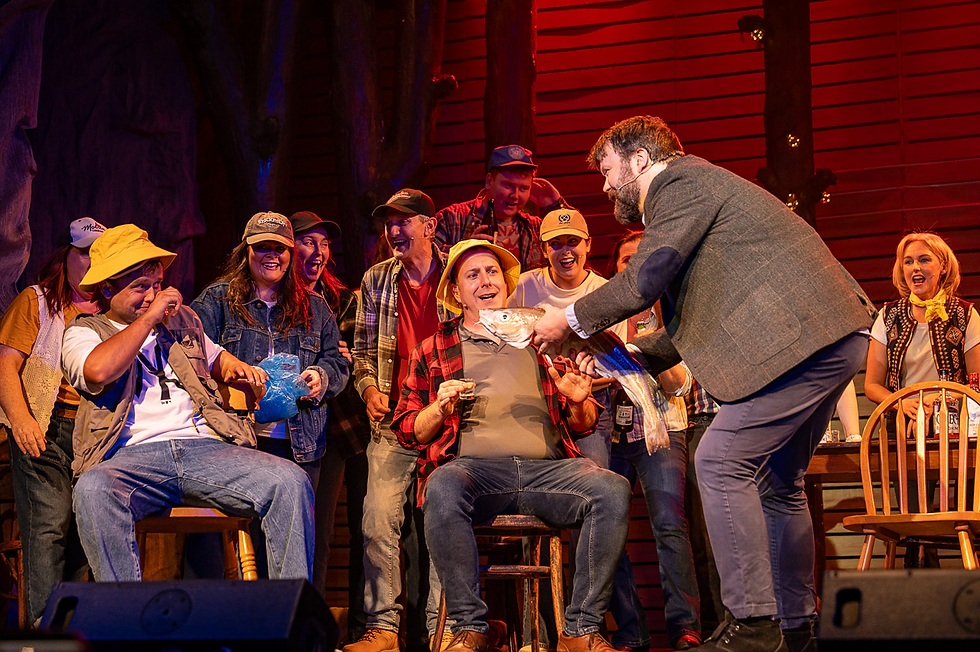
Among the cast, individual performances stood out for their emotional precision and genuine humanity. Angela Staunton’s portrayal of Beverley was deeply compelling. She embodied the pioneering pilot with strength and vulnerability, shifting effortlessly between her various roles. Her rendition of “Me and the Sky” was one of the evening’s most poignant moments, heartfelt, inspiring, and vocally superb. Angela’s clarity and authenticity made her a magnetic presence throughout.
Christine Connor was equally engaging as Diane, capturing the character’s gentle humour and warmth. Her chemistry with Patrick Byrne’s Nick was tender and believable, their scenes unfolding with quiet sincerity rather than forced sentimentality. Christine’s singing was expressive and secure, her tone consistently appealing. A more pronounced physical transformation between Diane and her other roles might have enhanced the clarity of her multi-rolling, but her emotional truth never wavered.
Jay Origan brought a riot of humour and humanity to Beulah, delivering one of the production’s most memorable performances. Her comedic timing was impeccable, and her ability to shift from laughter to tenderness with ease gave her portrayal real depth. Even when her accent faltered, her natural charisma carried the character. She lit up the stage, embodying the warmth and resilience of Gander’s people.
Sarah Kenny’s Hannah was the emotional anchor of the piece. Her performance of “I Am Here” was heartbreakingly tender, full of quiet strength. Sarah conveyed grief with restraint rather than melodrama, making her portrayal all the more moving. Her sensitivity as a performer made every scene she touched resonate with honesty.
As Bonnie, Lisa Folan brought a delightful mix of awkward charm and gentle humour. She captured the essence of someone doing their best to help in extraordinary circumstances. Her chemistry with her fellow performers, particularly Jay Origan, was warm and believable.
Andrea Treacy was a strong presence as Janice, the nervous first-time reporter. Her energy and clarity of intention made her instantly likeable. She handled her character’s duality, switching between Janice and the confident flight attendant, with precision, though a slightly more exaggerated physical shift might have clarified it further. Vocally, she was confident and bright, an integral part of the ensemble sound.
Niall Conway’s Claude was charismatic and full of life. He combined humour with genuine leadership, making him a standout whenever he appeared. His accent work was solid, and his voice carried power and authority.
Patrick Byrne’s Nick was equally assured. His portrayal of the gentle, slightly awkward Englishman was endearing and nuanced, and his accent work was exemplary. Despite performing on crutches, Patrick maintained focus and physical control, his professionalism evident in every scene.
Martin Pierce, as Kevin J, was exceptional. His range of characterisation was astonishing, particularly in his portrayal of the Egyptian passenger, which was filled with quiet dignity. He demonstrated both emotional intelligence and strong technical ability, one of the production’s most versatile performers.
Norman Quinn brought warmth and grounded sincerity to Kevin T, creating a believable and touching partnership with Pierce’s Kevin J. A greater physical contrast in his secondary roles could have added an extra layer of clarity, but his voice and emotional connection were first-rate.
Jamie Callanan’s Bob was instantly likeable, relaxed, confident, and full of charm. His comic instincts were sharp, yet he never tipped into caricature. His smooth vocals added a mellow tone to the ensemble numbers, and his stage presence was easy and assured.
Brian Roche’s Oz provided solid support within the group, his warm voice and quiet reliability adding texture, even if his character distinctions were less defined than others.
The ensemble as a whole was a testament to teamwork. Their cohesion and discipline were extraordinary. The vocal blend, the synchronised transitions, and the emotional unity on stage reflected hours of careful rehearsal and a shared sense of purpose. While the additional chorus could have been integrated more frequently, their presence enriched the sound and expanded the sense of community. The ensemble moments, particularly “Welcome to the Rock” and “Something’s Missing”, were among the most powerful of the night, filling the space with sound, movement, and emotion.

Visually, the production struck the perfect balance between simplicity and imagination. The set’s rustic minimalism, wooden slats, plain furniture, earthy tones, created a world that could become anything. The design invited the audience to fill in the blanks, just as the people of Gander opened their doors to strangers. Lighting added atmosphere and texture, with subtle shifts that marked time and emotion. The use of backlight through slatted panels suggested both confinement and openness, a beautiful metaphor for the show’s central tension between fear and generosity.
Some technical inconsistencies in the lighting cues occasionally disrupted this otherwise strong design. The spots, though effective, sometimes appeared overly bright or mistimed. Yet the overall concept was clear and appealing, with a painterly understanding of tone and texture. Sound design, on the other hand, was consistently excellent. Every voice was clear, every harmony balanced, and the relationship between band and singers felt perfectly judged. In a show where all characters remain visible throughout, that clarity is no small feat.
Costume choices were understated but highly effective. The layered, neutral clothing allowed actors to switch identities quickly while maintaining realism. Each look suggested something about the person, from business traveller to volunteer cook, without ever feeling overdesigned. Hair and make-up followed the same principle of authenticity. Nothing was exaggerated; everything served the story.
Behind all of this, the stage management was remarkably smooth. With the cast managing transitions themselves, every scene change felt integrated into the action. The movement of chairs and tables became part of the show’s heartbeat, demonstrating trust and collaboration within the company.
It was, however, the atmosphere in the auditorium that ultimately defined the evening. On this particular date — September 11th — the story’s themes carried an extra layer of resonance. The audience’s silence during moments of reflection and their spontaneous applause during moments of hope created a sense of shared emotion that few productions achieve. By the time the final notes faded, it was clear that Bravo Theatre Group had delivered something truly special: a production that not only entertained but also honoured the spirit of empathy that Come From Away celebrates.
The Front of House team mirrored that same spirit of kindness. They greeted audience members with warmth and care, ensuring that everyone felt welcomed and comfortable. Their calm professionalism complemented the company’s work on stage, bookending the evening with the same sense of community that defined the performance itself.
Bravo Theatre Group’s Come From Away was more than just a musical, it was an experience of shared humanity. Executed with heart, precision, and respect, it stood as a moving reminder of how, even in moments of crisis, people can come together to do something extraordinary.


Comments