
Review: RENT - Muse Productions
Updated: Feb 26
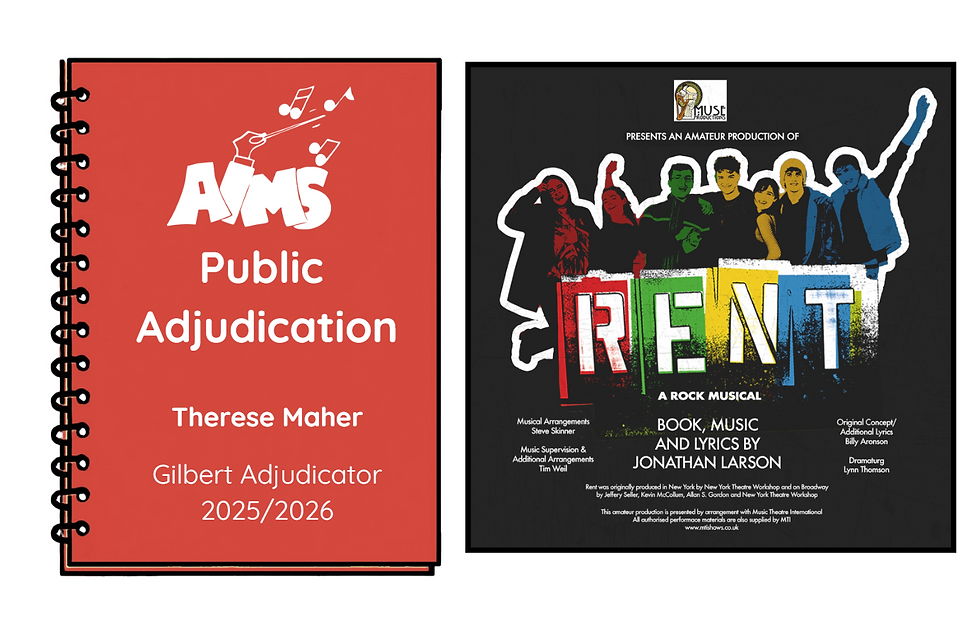
Society name: MUSE
Show name: Rent
Adjudicator date of attendance: 01/11/2025
MUSE’s production of Rent was an exceptionally powerful and deeply affecting evening of theatre, one that demonstrated not only the company’s immense artistic capability but also their collective willingness to meet this famously demanding musical with honesty, bravery, and emotional intelligence. From the moment the audience entered the space, there was an unmistakable charge in the air, a sense that this production would not merely restage Jonathan Larson’s iconic work, but reinterpret it, inhabit it, and live inside its tension, its sorrow, and its hope. It takes a remarkable level of maturity to handle a show that grapples so openly with grief, addiction, illness, poverty, and the fierce, complicated love that defines chosen family. This young company rose to that challenge with astonishing sensitivity.
The atmosphere of the production had an organic immediacy that suited Larson’s raw rock-opera score completely. Rather than leaning into gloss or decorative staging, the creative team embraced a stripped-back, emotionally centred approach that placed the performers and the relationships at the core of the storytelling. As a result, the audience experienced a version of Rent that felt urgent, intimate, and alive. Moments unfolded with the sense that emotions were being discovered in real time, and that energy created a palpable link between those onstage and those watching.
At the heart of this exceptional production was the direction of Martin McNelis, whose work was nothing short of extraordinary. What emerged onstage was not simply a polished staging of a well-known musical, but a cohesive, deeply considered artistic statement. McNelis’s use of the thrust stage was particularly inspired. Working in such a format can easily result in fractured staging or blocked sightlines, yet here the space was used with intuitive intelligence. Every angle offered new depth, and the blocking-maintained audience engagement no matter where one was seated. The intimacy of the configuration allowed the emotional reality of the piece to circulate freely, giving the production an immediacy that drew viewers completely into its world.
Martin’s attention to character development was equally impressive. Every person onstage felt fully realised, possessing a history and emotional landscape that informed their every interaction. Relationships, whether romantic, platonic, strained, or newly discovered, were handled with rich nuance. The pacing of the production was also superb. High-energy ensemble moments were contrasted with stillness when the story demanded it, creating a natural ebb and flow that carried the audience through the highs and lows of the narrative without ever feeling manipulated. The emotional arcs felt organic, earned, and profoundly human. The seamless cohesion between direction, musical direction, and choreography made the artistic team’s collaboration appear effortless.
Musical director Mary-Rose McNally crafted a sound world that honoured both the rock pulse and the tender vulnerability of Larson’s score. The small band produced a wonderfully rich sound, never overwhelming the cast yet offering full support to their vocal and emotional delivery. The coordination between Roger’s onstage musical moments and the live guitar was handled with impressive precision, particularly in the opening sequence, which can so easily go astray. Throughout the show, the balance between band and vocals was finely tuned, allowing every lyric to be heard clearly, essential in a show where storytelling lives in the musical phrasing. The ensemble harmonies were exceptional: warm, well-blended, and confidently sustained. Mary Rose ensured that each vocal moment served the narrative and emotional truth of the story, and the ensemble responded with a unity that felt deeply rooted in shared purpose. Tempos were steady, thoughtful, and always in service to the heart of the moment, guiding the show’s momentum without ever rushing its dramatic beats.
Choreographer Jay Molyneux contributed movement that felt inseparable from the storytelling. Rather than layering dance on top of the action, the choreography emerged naturally from the characters’ emotional states. One of the most striking examples was the canon movement in “Will I?”, executed with a kind of quiet transcendence that amplified the collective fear and fragility expressed in the song. The piece rippled with empathy. Conversely, high-energy numbers such as “Rent” and “La Vie Bohème” burst onto the stage with explosive joy and youthful electricity. The energy was chaotic in all the right ways yet always controlled, carrying the frenetic pulse of the characters’ world. Jay demonstrated a sophisticated understanding of when movement should drive the narrative and when it should simply support it, and the ensemble delivered that vision with conviction.
Among the principal cast, there was not a single weak performance. Each actor approached their role with sincerity, vulnerability, and a clear understanding of their character’s emotional pulse.
Conor McNelis gave a beautifully nuanced portrayal of Mark Cohen, the filmmaker forever one step removed from the world he documents. His performance captured Mark’s longing to belong without compromising the character’s gentle observational quality. Conor’s vocal delivery was effortless and clear, but it was his grounded emotional restraint that made the portrayal particularly compelling, a subtle masterclass in quiet, introspective performance.
As Roger, Nathan Canning offered a raw and deeply felt portrayal of the tortured musician battling grief and fear while yearning for connection. His interpretation never once felt melodramatic; instead, it carried an authenticity that made his pain and hesitation profoundly moving. “Your Eyes” was sung with such emotional fracture that the audience felt every ounce of heartbreak woven through his voice. His chemistry with Mimi was electric, tender, and at times turbulent, exactly as the relationship demands.
Aoife McNelis delivered an extraordinary Mimi: seductive yet vulnerable, playful yet broken, fighting her way through addiction while clinging desperately to love. Her portrayal was layered with subtle choices that revealed the character’s fragility beneath her bravado. Vocally, she possessed a smoky depth perfectly suited to the role, and her emotional delivery was compelling in every moment.
Cian Ryan’s performance as Tom Collins was a standout of exceptional emotional truth. His love for Angel radiated from him with absolute authenticity, crafting a romantic connection that felt painfully real. His grief during “I’ll Cover You (Reprise)” was almost unbearable in its honesty, a quiet, devastating display of heartbreak that left the audience breathless.
As Angel, Ethan Doyle lit up the stage with warmth, joy, and emotional generosity. Every choice was sincere, every movement imbued with purpose. His relationship with Collins felt gentle and deeply lived-in, adding a powerful emotional anchor to the production.
Aoife Daly’s Maureen balanced comedic flair with a vulnerable emotional core, capturing the character’s contradictions with intelligence and wit. “Over the Moon” provided much-needed levity and was performed with fearless humour.
Shauna Byrne’s Joanne complemented her beautifully, grounding the relationship with strength and emotional clarity. Her vocals were rich and assured, offering a compelling counterpoint to Maureen’s chaotic charm.
Cillian Fahy’s Benny was sharply defined: smarmy, entitled, and dripping with well-placed charm that always felt slightly too slick to trust. His portrayal added necessary tension to the story, highlighting the moral divergence between him and the group he left behind.
The ensemble formed the backbone of the production, lifting every scene with their vitality, specificity, and unity. Each performer crafted a distinct character, making the world feel inhabited rather than populated. Their vocal blend was consistently strong, and their commitment to the choreography, regardless of natural ability, was admirable. They never felt like an extension of the principals but rather an indispensable part of the story’s heartbeat.
Stage management, led by Brian Dowling, ensured absolute fluidity throughout. With cast-led transitions, precision was essential, and the team achieved seamless shifts that preserved the emotional pulse of the narrative. The set design embraced simplicity, using the thrust staging and minimal props to create an adaptable, multi-locational environment. This choice encouraged the audience to fill in visual detail while allowing the performers’ relationships to remain central.
Technically, the production excelled. The lighting design was atmospheric and deeply evocative, using shadows, colour, and beam direction to heighten moments of intimacy, chaos, or despair. It never distracted from the story but enhanced it with artistic sensitivity.
The sound design was flawless, no easy task in a rock musical. Every line, every harmony, every instrumental layer was clear and balanced, creating a sonic landscape that allowed the emotional nuance of the performances to shine.
Costumes, hair, and make-up were meticulously conceived, capturing each character’s identity and journey. The ensemble’s transformations were handled with precision, allowing for quick shifts in role that remained visually coherent.
Front of House operations contributed significantly to this experience. Patrons were greeted with a sense of warmth and clarity, guided through the space with ease, and welcomed into an environment that felt safe and inclusive, an important consideration for a production so heavily rooted in themes of belonging, vulnerability, and community. The FOH team set the tone beautifully, establishing a sense of calm professionalism that allowed the audience to settle into the emotional terrain of the piece before a single note was played.
In every respect, this was a remarkable production, emotionally courageous, artistically cohesive, and performed with rare sincerity. MUSE delivered a Rent that honoured the soul of the piece while offering a deeply personal and contemporary interpretation, leaving the audience profoundly moved and reminded of the enduring power of community, love, and chosen family.
Photography by Ian Collins


Comments