
Review: The Clockmaker’s Daughter - Avonmore Musical Society
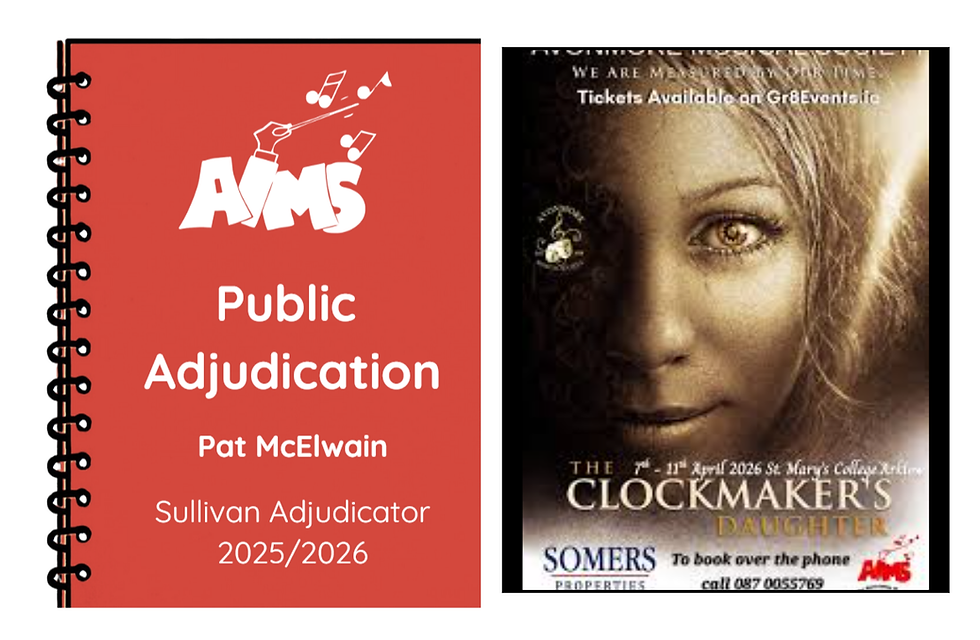
Society name: Avonmore Musical Society
Show name: The Clockmaker’s Daughter
Adjudicator date of attendance: 11/04/2026
There is something really magical about ‘The Clockmaker’s Daughter’. It is like a whimsical fairytale with the most beautiful score but underneath that lies a story with so much heart and emotional depth. It is a show that asks important questions about belonging and acceptance. Avonmore Musical Society embraced all of that beautifully in their production at St Mary’s Hall, Arklow. The story was told with imagination, sincerity and affection, giving us a wonderfully warm night at the theatre. It had everything that is good about amateur musical theatre, with its strong emphasis on community, imagination, talent and, above all else, real heart.
Great effort had gone into the front of house experience. The foyer was very nicely decorated, continuing the steampunk aesthetic of the production with visible cogs front of house. There was a warm and welcoming atmosphere from the moment we arrived. Front of house staff were friendly, approachable and clearly proud of the production they were presenting. It all contributed nicely to the evening and set a lovely tone for what was to follow on stage.
Amy Penston Hendley directed the production with a confident and very thoughtful hand. It was clear that she understood the heart of the piece. Underneath the fantasy and fairytale elements of ‘The Clockmaker’s Daughter’ lies a story about fear of difference and the speed with which ordinary people can be swept up in mob mentality. Those themes, so relevant in today’s world, came across strongly. Ms. Penston Hendley found a lovely balance between the story’s comedy and emotion. There was great attention to narrative detail throughout. Scene transitions flowed very smoothly and contributed to the show’s excellent pace. There were many beautifully realised moments throughout the show. ‘Where You’ll Be’ was stunning both visually and emotionally, with beautifully simple staging, gorgeous lighting and superb vocals capturing the storybook quality of the piece. There were also lovely smaller details throughout the show. Abraham pausing to touch the workshop door after Will had been shot was a beautiful directorial choice, saying so much in one simple action. Likewise, the moment of Will leaving a flower beside Constance’s statue had genuine emotional sincerity. Overall, this was superb work with tremendous heart and skill in what is a deceptively difficult show to direct well.
Martina Murphy’s choreography was very successful throughout. Ms. Murphy’s work was all about telling the story and contributed hugely to the building of character, atmosphere and emotion. There was a lovely sense of energy and optimism in ‘The Turning of the Key’, with appropriate, natural movement giving the village of Spindlewood great life and personality. There was particularly lovely work in ‘A Modest Modiste’. The seamstresses’ choreography using the measuring tapes had a nice softness and elegance to it and the final picture was especially beautiful. ‘Raise a Glass’ was one of the standout choreographic sequences of the evening. The celebratory dancing was joyful and infectious, with excellent high-energy movement. I really admired the dramatic movement used during ‘Fear and Whispers’. The broken clockwork-inspired physicality from the ensemble worked brilliantly in reflecting the growing fear, suspicion and mob mentality spreading through the town. Excellent storytelling through choreography.
Conor McCarthy did stunning work as musical director, bringing Michael Webborn and Daniel Finn’s gorgeous score to life with great care and sensitivity, ably assisted throughout by chorus mistress Jennifer Lee. Principal singing throughout was consistently excellent. What stood out most, however, was the quality of the ensemble and choral singing. From the opening moments of ‘The Turning of the Key’, the chorus produced a wonderfully full and confident sound with their exceptional harmonies. ‘Raise a Glass’ was musically outstanding. The power and energy of the ensemble vocals was stunning, adding hugely to what was one of the show’s most memorable sequences. The orchestra was excellent and complemented the vocals beautifully. Overall, an exceptionally high musical standard throughout.
Áine Kinch gave a superb performance as Constance, capturing both the innocence and emotional complexity of the character with great sensitivity throughout. There was something truly captivating about this performance. Ms. Kinch embraced Constance’s childlike curiosity and naivety so well and also allowed her humanity to emerge little by little as the story unfolded. Vocally, she was outstanding. Her performance of ‘Impossible’ was stunning, delivered with tremendous control and emotional honesty. It was one of those pin-drop moments where the audience was completely drawn into the performance. ‘A Story of My Own’ was another lovely moment, with Ms. Kinch beautifully capturing Constance’s growing self-awareness and emotional awakening. Dramatically, she was so impressive. Ms. Kinch paid great attention to the physicality of the role. Her precise posture and movement made her very believable as someone who was not quite fully human. Excellent work all round from Ms. Kinch.
Daniel Furlong was outstanding in the dual role of Storyteller and Will, giving a performance which was full of warmth, sincerity and emotion throughout. Mr. Furlong had an easy charm and a wonderfully engaging presence. There was something incredibly natural about his performance and he was utterly believable from beginning to end. As Storyteller, he established an immediate rapport with the audience, with great confidence and ease. As Will, his understanding of dialogue and pace was exceptional. His developing relationship with Constance was beautifully handled. His singing was equally exceptional. Vocals were expressive and effortless, always telling the story. He impressed greatly in ‘If You Could See My Heart’, with excellent vocal technique and a great understanding of the lyrics, delivered with genuine emotion. An exceptional performance from a hugely talented performer.
Andrew Docherty gave a superb portrayal of the clockmaker, Abraham. Abraham is such a complex character. He is a grieving father and a man desperately trying to hold on to something he has lost. He has so much love but also fear, guilt and sadness. It is a role that can easily become overly stern or distant but I thought that Mr. Docherty found the humanity in Abraham beautifully. He brought wonderful sympathy to the role, as we saw his flaws and fears but still we remained emotionally invested in his story. He sang very well throughout. ‘You Are Still Here’ had great feeling and sincerity, with a warm and expressive baritone and excellent acting through song.
Emily Davis was very strong as Amelia Kelly, bringing great intelligence and emotional understanding to the role. There was a real sense of thought behind every interaction. As an actress, she was consistently impressive. Ms. Davis brought a lovely, natural quality to her performance. Vocally, she was equally strong. ‘Raise a Glass’ showed the quality of her voice beautifully. Overall, a very thoughtful portrayal throughout.
Joanne Logue delivered an excellent performance as Ma Riley, full of energy, personality and presence. As the central antagonist she embodied the darker themes of the show but also provided much of the show’s humour and larger-than-life characterisation. Striking the right balance between the two is not easy but Ms. Logue handled it extremely well. Characterisation was consistently strong throughout. She had excellent stage presence and a wonderful physicality. Comedy was very well handled too, creating a figure who was entertaining while still allowing us to see the darker, more spiteful side of the character as the story progressed. That transition into the more unpleasant and dangerous Ma Riley was very convincingly played by Ms. Logue.
Kevin Macken was very impressive as Henry Glynn, creating one of the most memorable supporting characters of the show. What impressed me most was the intelligence behind Mr. Macken’s performance. His acting was so natural and believable throughout. His comic timing was excellent. Small moments, such as his attempts to retrieve the watch or his realisation that Amelia’s dress would not be ready until Monday, were played with great understanding of the humour. A really memorable supporting performance, played with charm and intelligence throughout.
Seán Hendley brought great warmth and a light comic touch to his portrayal of Mayor Glynn. Mr. Hendley’s strength as a character actor showed throughout in the confidence and detail of his performance. He found lots of humour in the role but in a most natural way, never pushing the comedy, ensuring that Mayor Glynn was authentic and believable. Overall, wonderful work throughout from Mr Hendley, in a portrayal that was full of lovely character detail.
The very committed ensemble work throughout was highly impressive and a huge part of why the show worked so successfully. There was constant life and character within the community of Spindlewood and a lot of effort had clearly gone into developing this. The seamstresses in particular were excellent throughout. Orlagh Sunderland as Rhiannon, Zoe Cummins as Mary, Izabela Wong as Jane, Molly-Rose Smith as Lucille, Niamh Harper as Moll, Erin Connolly as Cara and Amber Doyle as Sue worked beautifully together both during ‘A Modest Modiste’. Their singing was wonderfully blended, while their movement and interactions were well-rehearsed and in tune with the narrative. Strong support also came from Tomás Byrne as John, Eoghan Kinsella as Sam, Fionn Vigors as Ted, Gary Joyce as Jim, Callum Murray as Dave and Elaine McMahon Dossett as Mab, all of whom contributed greatly to Spindlewood’s sense of community. Fiona Redmond also made a very strong impression in her cameo appearance as Mrs. Reece. Musically, the ensemble was outstanding. Their singing was excellent and it was obvious that an enormous amount of rehearsal had gone into the choral work.
Barry Ryan and his crew did absolutely outstanding work. ‘The Clockmaker’s Daughter’ can be a challenging show, with its constant shifts between interior and exterior locations and its fast transitions. Thanks to an exceptionally well-rehearsed crew, the entire operation ran with remarkable smoothness and precision. The choice to costume crew was a clever one, ensuring that we were never pulled out of the fairytale world of Spindlewood during transitions. The trucks themselves were moved incredibly smoothly and meant that the whole production flowed with remarkable fluidity. The result was stage management of an exceptionally high standard throughout.
Set design was quite beautiful and captured the magical, storybook quality of ‘The Clockmaker’s Daughter’ wonderfully well. I loved the steampunk aesthetic, with oversized cogs and clockwork imagery creating a most atmospheric playing space. The trucks for Abraham’s workshop and Ma Riley’s shop were very impressive. Each had lovely detail and character. The bridge was another gorgeous piece of design, which reinforced the fairytale feel of the production. Overall, it was a set which facilitated the storytelling beautifully, full of atmosphere and great detail. A credit to all involved.
The lighting design was, at its best, absolutely stunning. It was often atmospheric and visually beautiful, contributing greatly to the magical, storybook feel of the production. There were so many times where lighting, set, haze and performance came together in really breathtaking ways, creating some stunning stage pictures. ‘A Story of My Own’ was particularly well handled, with the moving light tracking Constance with impressive precision and subtle changes in colour beautifully enhancing the mood. Likewise, the moment Constance first appeared in ‘Spindlewood’ was wonderfully captured. The rippling effects in the bridge scene were another lovely touch. ‘Fear and Whispers’ featured very dramatic lighting which heightened the growing tension so well, while ‘If You Could See My Heart (reprise)’ was visually stunning, with powerful backlighting and beams cutting through haze to create a very powerful effect. Moments like these showed exactly how effective lighting can be when fully focused on atmosphere and storytelling.
Sound was in extremely capable hands throughout. There was great warmth and balance from the orchestra. There was a lovely clarity within the orchestra mix too, with key instruments featured when required. The vocal sound was equally impressive. Mic EQ levels had been carefully set, giving a warm and full sound for both dialogue and singing. There was great balance too in the ensemble and choral work. With so many microphones in use and so many busy ensemble sequences in the show, this was all the more impressive. The sound effects work was also excellent throughout. Effects such as the turning of Constance’s key and the sound of running water were very well chosen and timed perfectly within the action.
The costume design complemented the fairytale atmosphere of the production and worked very well within the steampunk-inspired visual. The costumes hinted at a rustic, old-world setting through the use of waistcoats, aprons, layered skirts, braces and earthy fabrics. There was nice individuality within the villagers’ costumes, adding greatly to the authenticity. Constance’s costumes reflected the character’s innocence and uniqueness extremely well. Her green dress during ‘Raise a Glass’ was especially striking, setting her apart while drawing the audience’s eye towards her during what was one of the production’s biggest ensemble numbers. Excellent work from all involved.
The props department did superb work throughout, with excellent attention to detail. Abraham’s workshop in particular was beautifully realised and detailed. The various plans and sketches were beautifully realised and the clocks, books, tools and mechanical objects, ensured that the workshop looked most authentic. Mayor Glynn’s all-important pocket watch was another excellent prop choice. The market scene also featured great props work. The crates, logs and fish brought excellent life to ‘Market Day’.
Hair and makeup were very strong throughout. Constance’s look was especially impressive with an almost porcelain quality to her appearance, while the subtle mechanical influence within her eye makeup was a very clever touch. Mayor Glynn’s wig, sideburns and moustache suited his character perfectly. Male ensemble members’ sideburns were also very authentic and reinforced the overall attention to detail from the hair and makeup department.
Avonmore Musical Society’s production of ‘The Clockmaker’s Daughter’ was, above all else, a show full of heart. Underneath the fantasy, clockwork imagery and fairytale atmosphere was a beautiful story, so well told by a wonderful production team, cast and crew. There was something really uplifting about spending an evening watching a show packed with imagination and magic. Avonmore Musical Society should be very proud of what they achieved. It was a beautiful night of theatre.
Pat McElwain
Sullivan Adjudicator 2025/2026



Comments